In our work as a holistic healing firm in India, we often meet people who say, “I understand my problem. I know why I react like this. But my body still panics.”
This is one of the most common struggles in emotional healing.
You may read books.
You may attend therapy.
You may gain deep insight into your childhood or patterns.
Yet, when a trigger appears, your heart still races. Your stomach still tightens. Your throat still closes.
This is where mind-body reaction psychology becomes important.
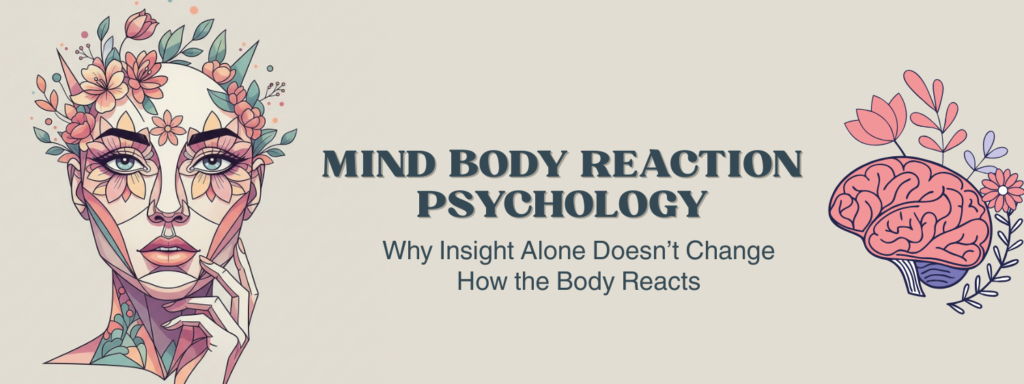
Understanding something mentally does not automatically reprogram how your nervous system reacts. In this blog, we will explore why insight alone is not enough, how the body stores reactions, and what truly helps shift deep emotional patterns.
What Is Mind Body Reaction Psychology?
Mind body reaction psychology studies how thoughts, emotions, and past experiences influence physical reactions in the body.
It explains why:
- A simple message can create anxiety.
- A small disagreement can cause shaking or sweating.
- A memory can bring tears instantly.
- A tone of voice can trigger fear.
Your body reacts before your thinking brain gets involved.
This is not a weakness.
This is biology.
The human system is designed for survival. And survival responses are fast.
Why Insight Feels Powerful But Often Isn’t Enough
Insight is important. It creates awareness.
You may realize:
- “I react strongly because my parents used to shout.”
- “I fear rejection because I felt ignored as a child.”
- “I overthink because I grew up in uncertainty.”
This awareness feels relieving. It gives clarity.
But clarity lives in the thinking brain, the prefrontal cortex.
Your reactions, however, come from deeper survival areas like the amygdala.
When a trigger appears, your body activates the survival system first. The thinking brain comes later.
That is why you may say:
“I know I am safe… but my body doesn’t feel safe.”
This is the heart of mind, body, reaction psychology.
The Nervous System Reacts Faster Than Insight
Your nervous system has one primary goal: protect you.
It does not check whether the danger is real or imagined.
If something reminds your system of a past painful experience, it activates:
- Fight (anger, irritation)
- Flight (avoidance, anxiety)
- Freeze (shutdown, numbness)
- Fawn (people-pleasing)
These reactions are automatic.
You cannot “logic” your way out of them instantly.
That is why simply telling yourself:
- “Calm down.”
- “This is not a big dea.l”
- “Stop overreacting.g”
does not work.
Your body does not respond to instructions.
It responds to safety.
How the Body Stores Emotional Memory
Many people think memory is only in the brain.
But emotional memory is stored in the body.
For example:
- A child who was criticized may develop tight shoulders.
- A child who felt unsafe may hold chronic stomach tension.
- A child who was ignored may feel heaviness in the chest.
Over time, these become patterns.
Even if you forget the event, the body remembers the feeling.
This is why mind body reaction psychology focuses not only on thought patterns but also on body awareness.
The body holds incomplete stress cycles.
If those cycles are never completed, the reaction repeats.
Why Talking About It Doesn’t Always Release It
Talking is powerful. It helps process experiences.
But talking alone may not release stored survival energy.
Imagine this:
You were chased by a dog as a child.
Your body froze.
The stress response was never discharged.
Now, years later, even seeing a small dog makes your body tense.
You may understand:
“That dog cannot hurt me.”
But your body remembers the old fear.
To heal this, you must:
- Help the body feel safe.
- Complete the frozen stress response.
- Regulate the nervous system slowly.
This is where breathwork, somatic healing, meditation, and trauma-informed therapy play a role.
The Gap Between Knowing and Feeling
One of the most painful experiences in healing is this gap:
“I know I am worthy… but I don’t feel worthy.”
“I know I am safe… but I feel anxious.”
“I know my partner loves me… but I still feel fear.”
Insight changes knowledge.
Regulation changes feeling.
In mind body reaction psychology, we understand that feelings change when the nervous system experiences repeated safety, not when the brain understands a concept once.
How Trauma Shapes Automatic Reactions
Trauma is not always a big event.
Sometimes trauma is:
- Growing up unheard.
- Living in constant stress.
- Experiencing emotional neglect.
- Feeling unsafe expressing emotions.
Small repeated stress over the years shapes the nervous system.
The body learns:
- “Stay alert.”
- “Do not trust.”
- “Do not relax.”
- “Stay prepared.”
Even when life improves, the body continues the old program.
Insight cannot override years of conditioning in one moment.
Healing requires repetition.
The Role of the Vagus Nerve in Emotional Reactions
The vagus nerve is a major part of the parasympathetic nervous system.
It helps:
- Slow the heart rate
- Regulate breathing
- Create calm
- Support digestion
If your vagus nerve tone is weak due to chronic stress, your body stays in survival mode.
That is why practices like:
- Slow breathing
- Humming or chanting
- Gentle yoga
- Meditation
- Grounding exercises
help more than overthinking.
They directly speak to the nervous system.
This is a practical application of mind-body reaction psychology in daily life.
Why Positive Thinking Is Not Enough
Many people try affirmations.
They say:
- “I am calm.”
- “I am safe.”
- “Everything is fine.”
But if the body feels threatened, affirmations feel fake.
The body trusts experience, not words.
Instead of forcing positive thinking, try:
- Noticing your body sensation.
- Slowing your breath.
- Naming the emotion.
- Place your hand on your chest.
- Sitting with the feeling without judgment.
Safety first. Belief later.
How Repetition Rewires Reactions
The nervous system learns through repetition.
Just like fear was learned through repeated stress, calm must be learned through repeated safety.
This means:
- Practicing regulation daily, not only during panic.
- Building body awareness slowly.
- Allowing emotions instead of suppressing them.
- Creating small safe experiences again and again.
Over time, the body updates its internal map.
This is how insight begins to integrate physically.
Signs That Insight Has Not Yet Reached the Body
You may notice:
- You intellectually understand your triggers.
- You explain your patterns clearly.
- You advise others easily.
- But you still feel overwhelmed in real situations.
This does not mean you are failing.
It simply means the body needs more direct work.
In mind body reaction psychology, we respect both mind and body equally.
Healing happens when they align.
Practical Holistic Tools to Shift Body Reactions
As a holistic healing firm in India, we combine traditional wisdom and modern neuroscience.
Here are tools that support deeper change:
1. Breath Regulation
Slow breathing signals safety to the nervous system.
Try:
- Inhale for 4 seconds.
- Exhale for 6 seconds.
- Repeat for 3–5 minutes.
Longer exhale = more calm.
2. Grounding Through the Senses
Notice:
- 5 things you can see
- 4 things you can touch
- 3 things you can hear
- 2 things you can smell
- 1 thing you can taste
This brings the body back to the present.
3. Body-Based Meditation
Instead of thinking about peace, feel:
- Your feet on the ground
- You’re back on the chair
- Your breath is moving in the chest
This builds a mind-body connection.
4. Emotional Completion
If you feel anger, allow safe movement:
- Shake your hands.
- Walk fast.
- Write and tear paper.
If you feel sadness:
- Allow tears.
- Hold yourself.
- Breathe deeply.
The body needs expression.
5. Safe Relationships
Healing accelerates when the body feels safe with another human.
Regulated nervous systems co-regulate each other.
This is why therapy, support groups, and conscious relationships matter.
Why Healing Is Slower Than Understanding
Understanding can happen in one session.
Rewiring takes months.
This is normal.
The body is cautious. It protects you carefully.
When it finally feels safe enough to relax, that is deep healing.
In mind-body reaction psychology, we teach patience.
You are not broken.
Your system is protecting you.
Can the Body Truly Change Its Reaction?
Yes.
Neuroplasticity allows the brain and nervous system to change.
But change happens when:
- Safety is repeated.
- Regulation is practiced.
- Triggers are faced gently.
- Shame is removed.
- Self-compassion increases.
Over time, you will notice:
- Triggers feel softer.
- Recovery becomes faster.
- Panic reduces.
- You pause before reacting.
That is real integration.
Final Thoughts: Insight Is the Beginning, Not the End
Insight opens the door.
But transformation happens when the body feels safe enough to walk through it.
Mind and body are not separate systems. They are deeply connected.
When you understand mind-body reaction psychology, you stop blaming yourself for reactions you cannot control instantly.
You begin to:
- Respect your nervous system.
- Build safety slowly.
- Practice regulation consistently.
- Replace self-criticism with compassion.
Healing is not about forcing change.
It is about creating safety until change happens naturally.
And when the body finally trusts that it is safe, reactions soften, not because you forced them, but because your system no longer needs to protect you the same way.
That is real, lasting healing.
Frequently Asked Questions About Mind Body Reaction Psychology
Below are common user-asked questions we receive in our healing practice.
Why do I still panic even after understanding my trauma?
Mind-Body Reaction Psychology explains why insight alone can’t change body reactions and how nervous system safety supports true healing.
How long does it take for the body to change reactions?
It depends on the depth and duration of past stress. Some people feel shifts in weeks. For deeper patterns, it may take months of consistent practice.
Is anxiety always psychological?
Not only. It is psychological and physiological. According to mind-body reaction psychology, anxiety is often a nervous system survival response.
Why does my heart race even when nothing is wrong?
Your body may be reacting to a perceived threat based on past experience. The nervous system does not always differentiate between old and current dange
Can meditation alone heal body reactions?
Your body may be reacting to a perceived threat based on past experience. The nervous system does not always differentiate between old and current dange